

AI Didn't Replace Experts. It Repriced Them.
Why expertise alone is no longer enough, and what the most trusted professionals are doing differently.

For most of our careers, we believed something simple.
If you became really good at your work...
You’d always be valuable.
So we studied.
Practiced.
Stayed curious.
Spent years solving problems other people couldn’t.
We became the people people called when things got complicated.
And for a long time...
That was enough.
Lately, though, I’ve noticed a different kind of conversation.
Not from students.
Not from people just starting.
From founders.
Executives.
Consultants.
People who’ve spent twenty or thirty years becoming experts.
The question isn’t:
“How do I use AI?”
It’s much quieter than that.
“Bobby... if AI can now do part of what I’ve spent my career learning... where does that leave me?”
I’ve heard versions of that question more times than I can count.
And honestly...
I don’t think we’re talking about it enough.
Because this isn’t really a conversation about AI.
It’s a conversation about value.
About identity.
About what happens when the thing you’ve relied on for years suddenly feels... less certain.
Over the past few months, I’ve been collecting stories, reading research, and paying close attention to what professionals are actually worried about.
One pattern kept showing up.
AI isn’t changing work in the way most people expected.
It’s changing how expertise is valued.
In this article, I want to share 10 observations I’ve made.
Some confirmed what I already believed.
Others challenged my thinking completely.
And one of them, the sixth insight, has become my favorite because I think it points toward the biggest opportunity hidden inside this moment.
1. The Quiet Shift Nobody Prepared Us For
Recently, I came across a post from an instructional designer.
She wrote about how much she loved creating learning experiences.
The research.
The writing.
The creativity.
The satisfaction of building something that genuinely helped people learn.
Then her company introduced AI into almost every part of the process.
Writing.
Design.
Quality assurance.
Reviews.
Her role slowly changed.
She described it in one sentence that I haven’t been able to forget:
“I’m basically a full-time AI wrangler now.”
That wasn’t a story about losing a job.
It was a story about losing the kind of work she loved doing.
And I think many professionals quietly recognize that feeling.
AI isn’t replacing everyone overnight.
It’s gradually changing what our work looks like.
Sometimes so slowly that we don’t notice until we no longer recognize our own role.
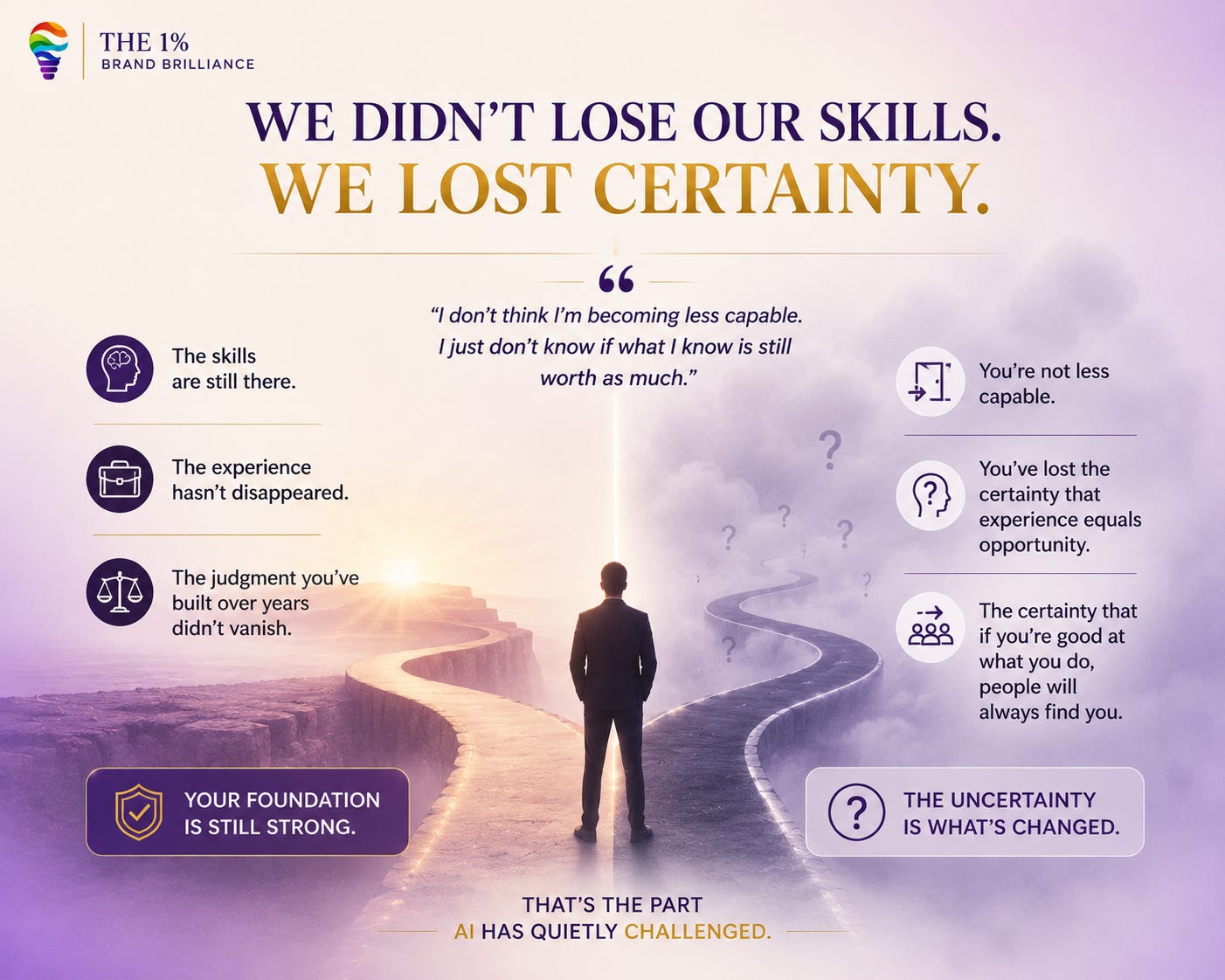
2. We Didn’t Lose Our Skills. We Lost Certainty.
Another post stopped me in my tracks.
Someone wrote:
“I don’t think I’m becoming less capable. I just don’t know if what I know is still worth as much.”
That sentence captures what so many experienced professionals are feeling.
The skills are still there.
The experience hasn’t disappeared.
The judgment you’ve developed over twenty years didn’t suddenly vanish.
What’s changed is certainty.
The certainty that experience automatically creates opportunity.
The certainty that competence is enough.
The certainty that if you’re good at what you do, people will always find you.
That’s the part AI has quietly challenged.
3. The Numbers Confirm What People Are Feeling
This isn’t just an emotional reaction.
The research points in the same direction.
McKinsey estimates that generative AI could automate activities that account for 60–70% of employees’ working time.
The World Economic Forum reports that 40% of employers expect to reduce parts of their workforce where AI can automate tasks.
Those statistics sound alarming.
But what interests me even more is who feels the pressure.
Not the absolute beginners.
Not the world-class experts.
It’s the people in the middle.
The professionals who spent years becoming “pretty good.”
Reliable.
Competent.
Dependable.
For decades, that was enough to build a successful career.
Today, the rules are changing.
4. Being “Pretty Good” Used To Be Enough
There was a time when standing out wasn’t necessary.
You simply had to do good work.
Deliver consistently.
Build relationships.
Let your reputation grow over time.
Today, beginners can use AI to become competent much faster.
Experts use AI to become even more effective.
And suddenly...
The middle feels crowded.
That’s why so many professionals seem anxious right now.
Not because they’ve become less capable.
Because they’re wondering how to become more valuable.
Those are two very different questions.
5. Everyone Is Learning AI. Very Few Are Building What AI Can’t Replace.
Most conversations today revolve around prompts.
New tools.
Better workflows.
The latest AI platform.
And those are useful skills.
You should absolutely learn them.
But I don’t believe prompt engineering is anyone’s long-term competitive advantage.
Technology keeps getting simpler.
Interfaces keep improving.
Eventually, almost everyone will have access to the same capabilities.
So if everyone can generate information...
What becomes scarce?
That question has been sitting with me for weeks.
And I think the answer changed the way I see expertise altogether.
🔒 Paywall for Free Subscribers
If you’re reading this as a free subscriber, this is where the article pauses.
The second half goes much deeper into:
Why judgment is becoming more valuable than knowledge
Why AI isn’t creating an expertise crisis—it’s creating a visibility crisis
The new hierarchy of value every professional should understand
Five practical ways to stay relevant in an AI-first world
And the one insight that completely changed how I think about expertise—my favorite lesson in this article.
Upgrade to continue reading.
